Set your question down. Let three cards help you see it anew.
✦✧✦✧
THE ORIGINAL DECK๑๙๐๙
A LITTLE LIGHT WITHIN✧
Hold a question, then shuffle
Whenever you’re ready, begin here.↓
Take a breath → Shuffle → Choose your cards
Need a question? Start with a real-life situation+
78 original cards · Choose your own three · A free reading
ONE DAY · ONE MOMENT
What might the universe whisper today?
Set the many questions aside. Give one card a little space today.
Choose one card · Keep it for 24 hours
Take a slow breath. Think of today. Begin when ready.
A hashed network address enforces the 24-hour interval; raw IP addresses are not stored. People sharing a network may receive the same card. Personal questions are never included in usage counts.
A MOMENT SHARED
Moments of pause, shared here
—visitors
— completed readings · — daily cards
Visitors are estimated by anonymous browsers. Refreshing does not add another visit; changing devices or clearing cookies may. Names and questions are never collected.
Support Tarn’s work
If this little card table made you smile, you can help me make more things to share.
From Italian card tables to small pictures people use to reflect on their lives.
6 short chapters · Plus a reading companion✧
The Wheel — an image of changing cycles
01 / BEFORE 1909
Before the oracle, there was a game
Imagine a card table in Italy centuries ago. Players are choosing their next move. Early evidence places tarot in fifteenth-century northern Italy as a game; some surviving luxury decks were carefully painted for wealthy patrons.
Later writers connected these pictures with occult systems and divination. The tarot familiar today carries several histories at once: playing cards, visual art and interpretations added over time.
In 1909, Arthur Edward Waite worked with Pamela Colman Smith on the deck now known as Waite–Smith. Waite brought an interest in spiritual symbolism; Smith brought experience in illustration, storytelling and theatre. William Rider & Son published the deck.
Take a moment with the Magician beside this passage. A cup, sword, wand and pentacle sit on the table. If these tools stood for what you already have, which would you reach for first? A small question like this offers a way into the picture before you have memorised every meaning.
Eight of Swords — notice the space between the blades
03 / 78 WINDOWS
When the smaller cards became scenes
Look at the Eight of Swords. The figure is bound and blindfolded, yet gaps remain between the swords. The picture suggests a useful question: which limits are external, and which possibilities cannot yet be seen? It does not establish that the viewer is literally in the same situation.
The illustrated minor cards are a defining feature of Waite–Smith. A worker, a departure or a gathering offers a scene to interpret. The same number means different things in different suits: the Eight of Pentacles concerns practice, while the Eight of Cups concerns leaving something unfulfilling.
✧
Ten of Wands — capacity does not make every burden yours
04 / FOUR SUITS · MANY WAYS TO SEE
Four suits, four ways of paying attention
In contemporary reading, Wands commonly concern energy and action; Cups, feeling and connection; Swords, thought and conflict; and Pentacles, resources and practical life. These associations are a useful map, not rigid boxes for every question.
Four suits of fourteen make fifty-six minor cards. The remaining twenty-two are the major arcana, including The Fool, The Star and The World. They are often read as broader experiences: beginnings, disruption and completion.
✧
The Star — hope accompanied by care
05 / A SMALL DETAIL
The Star follows the Tower
The Star follows The Tower in the major sequence. After lightning and collapse, a quiet figure pours water into a pool and onto the earth. Reading this as recovery is one possible interpretation, not a rule that life must follow the same order.
A familiar card can hold your attention differently on another day. You might notice the stars first, then the pouring hands later. A changed question can reveal a different detail without making an earlier reading wrong.
✧
The Hermit — enough light for a next step
06 / YOUR PART IN THE STORY
Where does the answer belong?
A useful question gives a reading somewhere to stand. A picture cannot verify another person’s private thoughts, but it can help you consider how to approach a conversation. In a spread, the card’s individual meaning, its position and your question belong together.
Keep what helps you understand your situation, leave what does not fit and check facts before important decisions. Sometimes the most valuable part of a reading is the uninterrupted moment you gave yourself.
READ AN EXAMPLE
One question, read through three cards
These cards were chosen to show how a reading works. This is an example to explore before drawing your own cards.
If I change jobs in the next three months, what may help and what needs preparation?
For changing jobs, this spread suggests that you try one manageable step, set a review point before committing more, and judge the result that follows.
How each card connects to the question+
The root
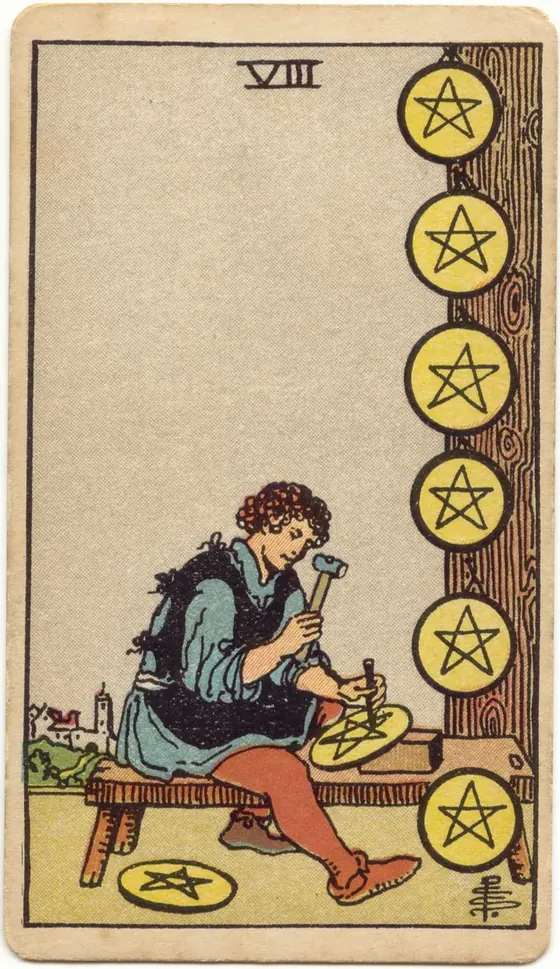
Eight of Pentacles
As the background to changing jobs, Eight of Pentacles invites you to examine practice and steady work. Choose one skill or preparation step and track actual duties, confirmed offer terms and what you want from a new role. Judge progress by actual work rather than worry.
What is present
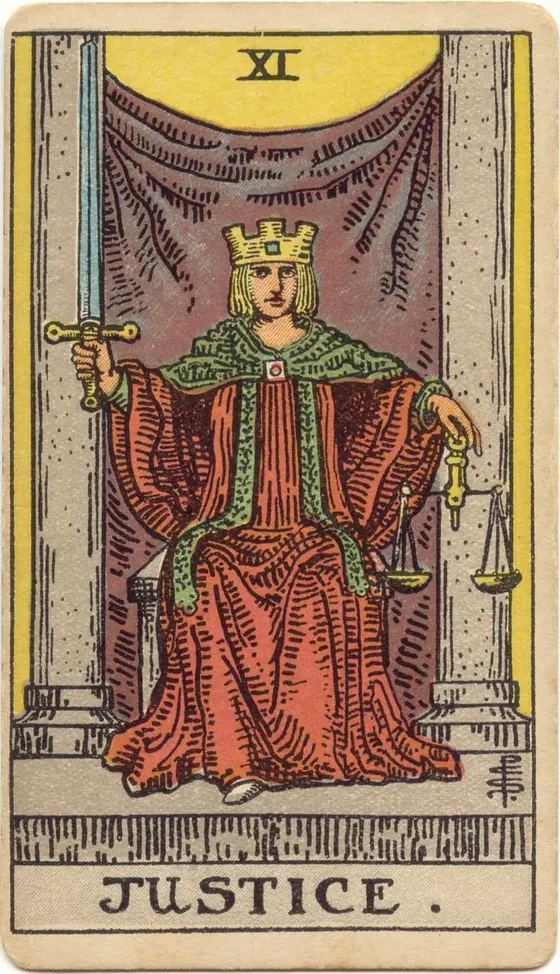
Justice
For changing jobs, Justice puts clarity and evidence in the position needing attention. Base the decision on actual duties, confirmed offer terms and what you want from a new role. Ask directly about unclear points instead of leaving different assumptions unspoken.
A possible next step
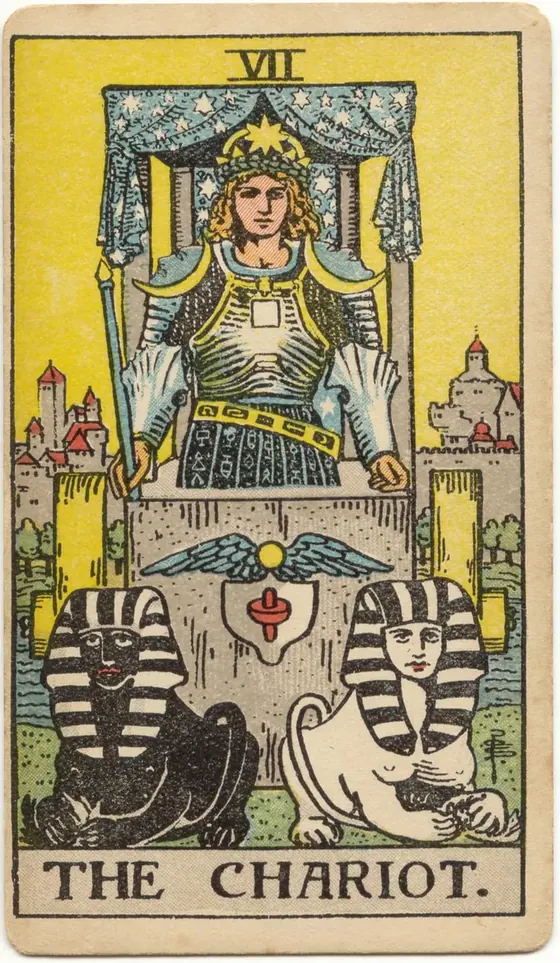
The Chariot
For the next step in changing jobs, The Chariot offers directed momentum as an approach. Choose one direction and let actual duties, confirmed offer terms and what you want from a new role tell you whether to proceed or adjust. Speed by itself is not progress.
What could you try next?
Choose one goal first and notice what actually moves you toward it. For changing jobs: Use the same criteria for both options and verify the offer before committing.
A COMPANION TO YOUR READING
Before you put the deck away, a few things worth knowing
Start with what you are wondering about—from choosing a spread to handling an unsettling reading.
A single focus✧
Three perspectives
ONE QUESTION, DIFFERENT WAYS TO LISTEN
One card or three: what changes?
More cards add perspectives, not a guaranteed increase in accuracy. Choose the spread that fits the question.
✧One card · A focus for today
Useful for a small question such as “What deserves my attention today?” It offers one theme to reflect on. This is the daily-card format here.
✧Three cards · Explore one situation
Here the positions are background, what needs attention and a next step. This suits a situation with several considerations, such as changing jobs. Positions are set before selection, not redefined to fit the result.
Three cards do not always mean past, present and future. Each spread assigns its own questions to the positions.
Do I have to believe for a reading to mean anything?
+
You do not need to prove your belief to sit at this table. Some people approach tarot as a personal ritual; others use the pictures to begin reflecting. Neither requires you to feel a special power.
Historically, tarot began as a European card game before its later association with divination. Beliefs about its powers do not establish that faith is required to receive the “right” card.
A picture or a broad sentence can feel personal when a concern is already on your mind. Psychologists use the term Barnum effect for the tendency to experience general descriptions as especially applicable to oneself.
Keep track of misses as well as matches. Ask whether a statement identifies something specific or whether you supplied the detail. This site does not assign an accuracy percentage or treat a reading as proof of a future event. You can find it useful without accepting every line.
On this site, a daily card can be chosen once per rolling 24 hours. The interval starts at selection, not midnight. You can return to the same card during that period; people sharing a network may share a result.
A three-card reading can be restarted after a round. For the same question, allow time to try a step or receive new information first: a conversation, an application response or your own review date. This is a suggested rhythm for useful reflection, not a spiritual requirement.
The same question gave me different cards. Which should I trust?
+
A new shuffle changes the order, so the images can differ even when the outside situation has not changed. Random selection alone gives no reason to treat the latest—or most frightening—result as more true.
If you keep drawing until you feel reassured, pause and name the answer you are waiting for. Keep one reading and return to real events. Extra draws cannot make another person respond sooner or supply missing facts.
Do different decks change the meaning?
+
Artwork and reading conventions vary. Waite–Smith gives the minor cards narrative scenes, while Marseille-style numbered cards commonly arrange suit emblems. Contemporary decks can change names or visual details again.
This site uses the 78-card Waite–Smith structure and reads every card upright. A tilt or turn during an animation does not add a reversed meaning. Upright cards still carry both possibilities and cautions.
What if a reading leaves me worried?
+
You can put the cards down. Intense images such as Death, The Tower or the Ten of Swords do not establish that death, injury or punishment will occur. Consider endings, changes or areas needing care without adding a disaster that has not happened.
Separate “what has happened” from “what I fear.” Choose one manageable response: clarify an agreement, pause an overloaded schedule or talk with someone you trust. This reading does not require you to pay for a ritual or keep drawing until you get a pleasant answer.
If the reading leaves you going in circles, close the page and take a break. A useful reading should leave room for your choices, not make you feel obliged to return.
What if I skip a day or do not follow the reading?
+
There is nothing to make up for. You owe this deck nothing and do not need a daily streak to protect your luck. Thinking, resting or talking with someone you trust are equally available choices.
A reading is something to consider, not an instruction. You can adapt or reject advice that does not fit. The point is whether you leave with more room to think and choose, not whether you return every day.
Return whenever you want, or take a break. Your life does not need permission from the cards.
✧
Historical information draws on The Metropolitan Museum of Art and The British Museum. Interpretations of imagery are reflective suggestions, not facts about a reader’s future.


 ✧✦✧
✧✦✧