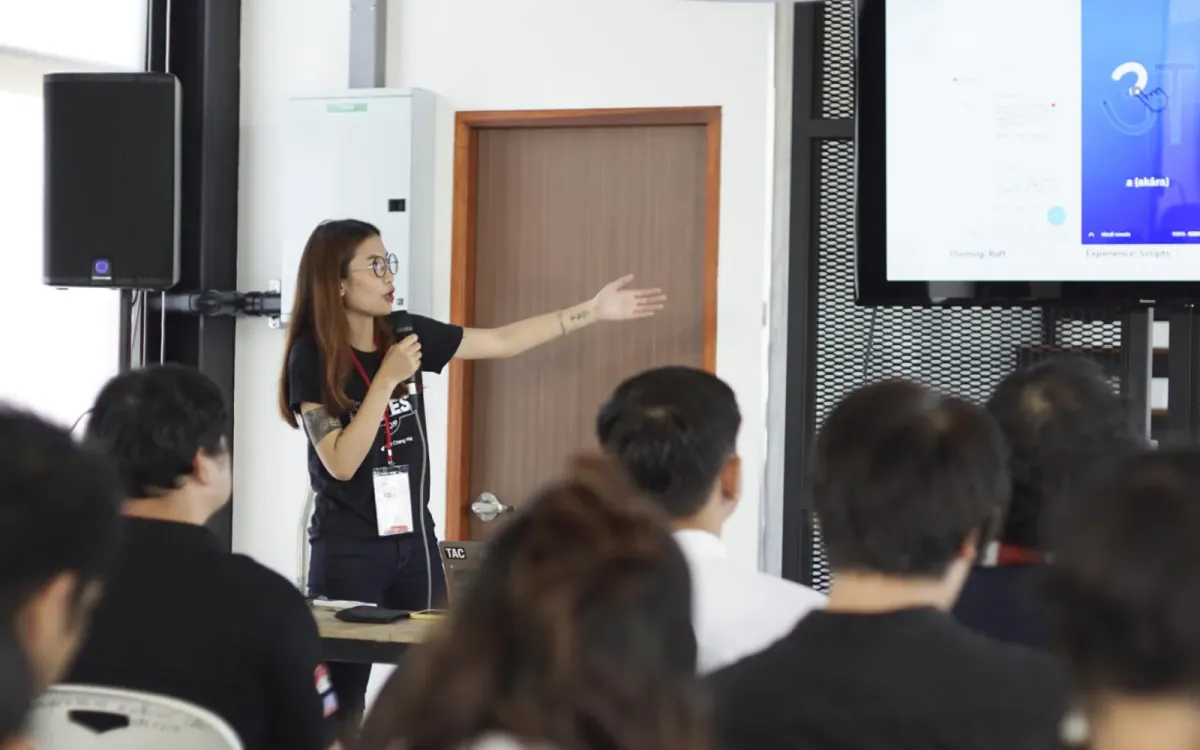
Tarn is a Product Designer from Chiang Mai who started down the path of digital product design from one simple question: “Why do some systems leave people feeling tired, when they're supposed to make work easier?”
From that question, Tarn grew up in UX/UI and Product Design — since 2017 — working on many kinds of products: learning apps for children, enterprise back-office systems, financial platforms, Web3, EdTech, SaaS and CRM, through to enterprise tools with complex rules and many kinds of users.
This work taught Tarn that good design doesn't always start from the prettiest screen. More often it starts in the messy stretch — when things are still tangled, still unclear, and there are more questions than answers.
Some projects begin with a flow so long that people get lost.
Some begin with so much data that no one knows what to look at first.
Some begin with an idea so new that it takes time to help people understand it and dare to use it.
So what Tarn loves about design isn't only the moment a finished piece looks good — it's the part where you slowly unpack the problem, ask questions, set priorities, cut what isn't needed, and turn the mess into an experience that's clearer, easier to use, and backed by reasons.
Over the years, Tarn has worked as a designer, a product owner, a design manager and a senior UX/UI designer — seeing products from many angles. Not just the screen, but the team, the client, the business, the developers, and the people who actually have to use the system every day.
Because of that, Tarn's design work usually sits right in the middle — between the systematic and the human.
Tarn cares about UX structure, information architecture, user flow, design systems and components that truly get reused — and, at the same time, about the small details: wording, empty states, feedback, the rhythm of reading, and the feelings that arise along the way.
Because often it's these small things that keep a piece of software from feeling rigid, distant, or more tiring than it needs to be.
Lately, new tools — AI especially — have made design much faster. Tarn sees this as a real opportunity for creative people, but still believes that what makes a piece of work feel right doesn't come from speed alone.
AI can help think, summarise, and explore many directions.
But there still has to be a person watching the context — choosing what matters, cutting what doesn't, and knowing when an answer that already looks good still isn't good enough for the people who'll actually use it.
For Tarn, design isn't only about making something complex look simpler. It's about making people feel that they understand, that they're in control, and that they're not left alone with a system that feels too cold.
In the end, Tarn still believes in work that holds clarity, care and warmth all at once.
Work that doesn't need to shout that it's good —
but once people use it, they move forward more easily,
the team carries on with more confidence,
and the product slowly becomes something that means a little more than before.
