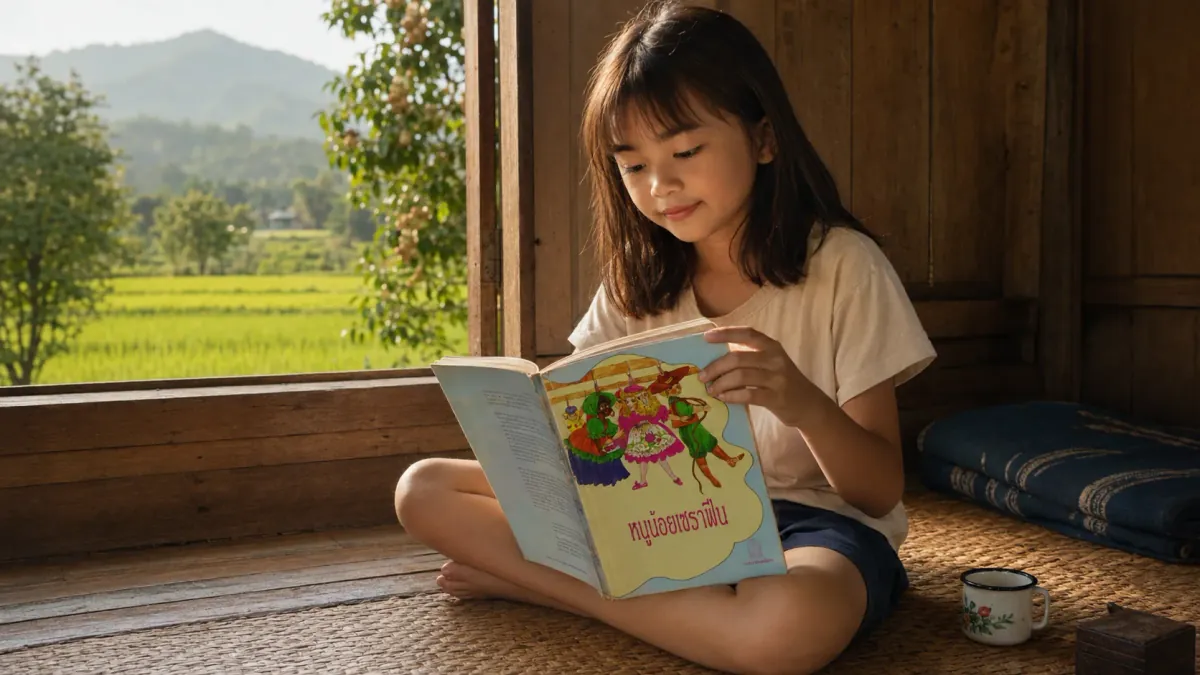
There's a book I can't fully remember. I recall the cover only faintly, and I no longer know where the copy went.
And yet a few images from inside it are still perfectly clear in my head.
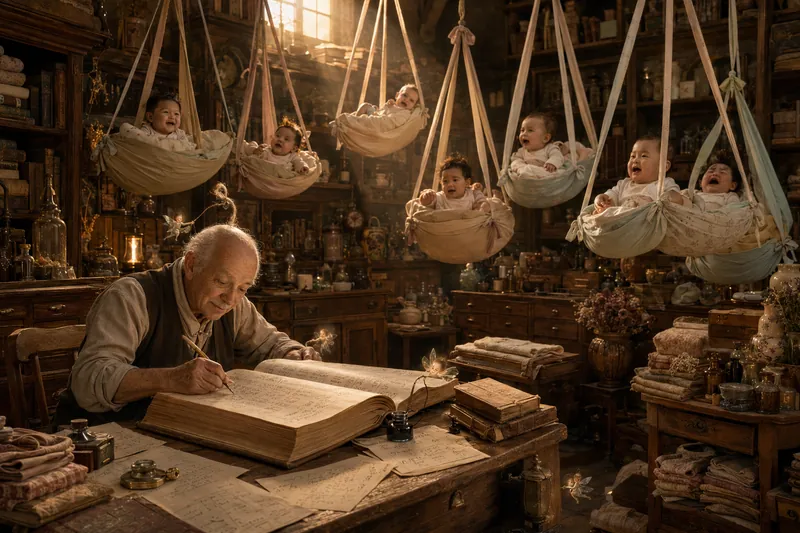
- A shop that sells babies, hung from the ceiling like balloons.
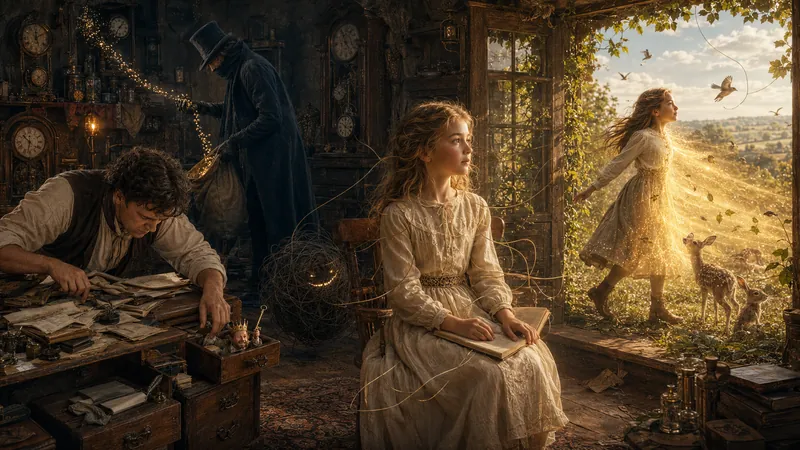
- A girl with invisible strings pulling at her from behind.
- A king who hides your things exactly when you're in a hurry.
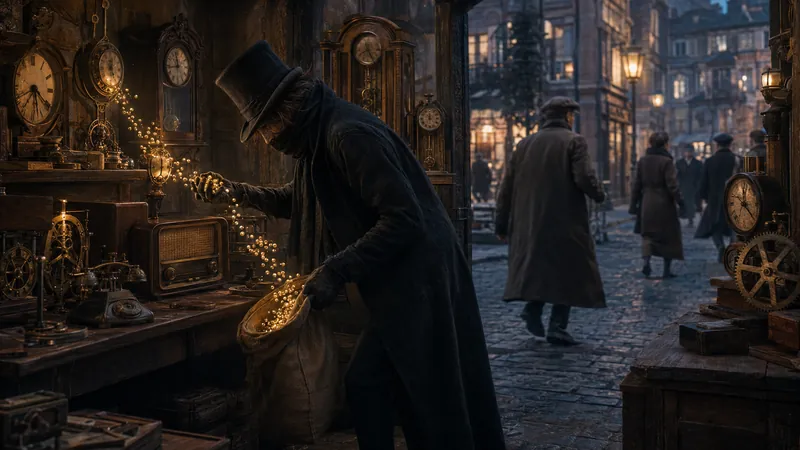
- A thief who steals time, one minute at a go — not money.
- A girl who became a sunbeam to go looking for her parents.
The book is Séraphine.
- Original title
- Séraphine ou les Ficelles de Paquet-de-Nerfs
- Author
- André Berge — a French doctor and psychoanalyst
- First published
- Flammarion, 1954
- Thai translation
- Poonsuk Tanprom
- Thai edition
- Ministry of Education, 1992 · 129 pages
Thai edition details from a second-hand bookshop listing · French edition from Flammarion / Fnac — the digital edition available today credits Jozef Wilkoń as illustrator.
I read it and kept it as a child. Picking it up again as an adult, it didn't feel the same at all.
As a child, you may see only a fantasy story with odd characters. As an adult, you start to see grown-ups in a rush, a child who can't control her own emotions, time that disappears without anyone noticing, and feelings that are still in us today.
By the time I realised all that, the physical book was gone.
So I wanted to write its story down here, and let this site be a small bookshelf for the things I don't want to lose a second time.
Not a book born in a consulting room, but from telling stories to children
André Berge was a doctor and psychoanalyst who worked in child psychology, family life and education.
But the four tales didn't start out as a manual for teaching children. They were told to an audience of children first — and at that moment Berge was simply a father telling stories to entertain his own kids.
That may be why the book can talk about difficult things — emotion, hurry, family relationships, self-control — without ever making a child feel lectured at.
The book collects four tales:
- Séraphine and the strings of the bundle of nerves Séraphine ou les Ficelles de Paquet-de-Nerfs
- The king of annoyances Le Roi des embêtants
- The thief of minutes Le Voleur de minutes
- The little girl who was a sunbeam La Petite fille rayon de soleil
All four do the same thing: they take a feeling you can't see and give it a body, so a child can point at it and talk about it.
1. Séraphine and the strings of the bundle of nerves
The tale
The first tale opens in a shop that sells no clothes, no sweets and no toys.
This shop sells babies.
Babies of every colour and size hang from the ceiling on long cords. Some laugh, some cry, some sing. The noise inside is not unlike a giant birdcage.
But the shopkeeper never gets a headache, because he is slightly hard of hearing.
He is an old man with exactly one hair left on his head, bent over a thick ledger doing difficult sums. Around him, tiny invisible sprites keep tormenting him — tugging that single hair, hiding his glasses, spilling his ink, tickling his feet until he laughs.
And still he works on as though nothing were happening at all.
One day a young couple, Monsieur and Madame Bonménage, walk in.
They are good-looking, good-hearted and very much in love — but they have one peculiar habit. They quarrel because each keeps trying to let the other one be right.
Asked whether they want a boy or a girl, one says a boy and the other says a girl. Hearing each other, both immediately change their minds — then change back, and back again, until neither can remember who wanted what.
Eye colour goes the same way. She wants the child to have his dark eyes; he wants the child to have her blue ones.
So the shopkeeper warns them not to put so much weight on what's visible from the outside. A child may not be perfect to look at, but if she is kind and clever, the parents will love her anyway — and wouldn't trade her for a beautiful child with an unkind nature.
When the two finally agree on something, the old man gives them a very special girl.
Her eyes look made from scraps of indigo sky. Her skin is like snow brushed pink by the late afternoon sun. Her hair is fine as gold, her heart is pure gold, and her mind is clear as crystal.
The girl is named Séraphine.
But just as her parents carry her out, a strange laugh rings out — an unfriendly sort of laugh, and it seems to come from the peacefully sleeping child herself.
The parents hear it. The hard-of-hearing shopkeeper hears nothing at all.
That's the first sign: even a child built to look as perfect as possible still has something hidden inside.

That something is called Paquet-de-Nerfs.
Paquet-de-Nerfs means literally “a bundle of nerves” — here, a knot of pent-up emotion coiled inside one child, with strings running out of it that work her like a puppet.
When the strings are pulled, Séraphine does things that contradict what she actually feels. She may love someone and behave as though she doesn't. She may know something is wrong and still not stop herself in time.
So the heart of the story isn't deciding whether Séraphine is a “good child” or a “difficult child.” It's the question of how she stops being a puppet of what lives inside her.
A sample of the French original is available at Numilog
Reading it as an adult
Read as a child, you picture a strange creature hiding in someone's heart.
Read as an adult, you notice every one of us has a Paquet-de-Nerfs of our own.
It shows up on the days we're exhausted, when several worries pile up at once, or in the moment we say something too harshly and sit with the regret afterwards.
Understanding that a string is being pulled doesn't mean we aren't responsible for what we did. But it does stop us concluding too quickly that we're simply a bad person.
Maybe some feeling is just pulling at us — and once we can see it, we get to choose whether to let it keep pulling, or to pause before we move with it.
2. The king of annoyances
The tale
The father of a boy named Japhi is a grown-up with something to do at all times.
And the more he hurries, the more reliably the thing he needs goes missing.
He needs the keys; the keys can't be found. He needs a document; that one sheet vanishes into the pile. Whatever he particularly needs is never where it ought to be.
That feeling — that someone is doing this on purpose — becomes a character: the king of annoyances.

Reading it as an adult
The best thing about this story is that it doesn't open by telling the adult he's careless or bad at running his life.
It opens by accepting the feeling: when you're in a real hurry, not finding one small object genuinely can feel like the whole world has ganged up on you.
Read today, that king may not be a creature behind the cupboard. He hides in the hurry itself — in the desk where we put things down without looking, in a brain juggling several thoughts, or in the irritation that makes the object right in front of us invisible.
Sometimes we don't need one more sentence telling us to be mindful. Sometimes we just need to stop, breathe, and admit that right now things really are chaotic.
And when the hurry shrinks, that king usually shrinks with it.
3. The thief of minutes
The tale
Thieves in most stories take money, jewellery, valuables.
The thief in this one takes something you can't see — and by the time you notice it's gone, there's no getting it back.
What he takes is time.
The tale is about the great many minutes swallowed by hungry machines, until that swallowing becomes part of modern life itself.
Reading it as an adult
What strikes me is that this book came out in 1954 — before smartphones, before social media, before notifications going off all day.
And yet the idea of time being stolen by the tools around us reads like it was written about our lives right now.
These days the thief doesn't need to break in. He lives in our phone. In the message that pops up mid-task. In the short clip we meant to watch exactly one of. Or in the stretch where we have so many things open that we can't remember why we picked up the phone.
The problem isn't that every minute has to be useful. Rest, idling and doing nothing at all have their own value.
The difference is whether we chose to spend that time, or only noticed afterwards that something took it before we got to decide.
This story isn't telling us to race the clock. It's reminding us to own our time again.
4. The girl who was a sunbeam
The tale
The last tale is about a girl who communicates better than any adult with animals, plants and everything else in nature.
When she has to find her parents, she turns herself into a ray of sunlight and travels out to look for them.
She sets out not with some formidable magic power, not with a sword, not by defeating anyone — but by turning herself into something warm and light that can travel anywhere.

Reading it as an adult
This story is about a capacity children have that adults tend to mislay along the way: looking at the world with real attention.
A child will still stop to watch an ant walk. Still wonder what a tree is feeling. Still hear the small sounds adults have decided don't matter.
As we grow up, we learn the names of more and more things — and sometimes see them less.
- We know what that tree is called, but we don't stop to look at it.
- We know how light works, but we don't feel its warmth.
- We know the fastest way there, but no longer what's along the way.
So the girl who became a sunbeam isn't powerful because she's stronger than anyone. It's because she's still connected to the world in a way adults have forgotten.
A children's book talking to adults
Looking at all four tales together, André Berge is doing one thing: turning what you can't touch into something you can picture.
- Emotion that controls usthe strings of a bundle of nerves
- The chaos that loses our thingsthe king of annoyances
- Time slipping awaythe thief of minutes
- Tenderness toward the worldthe girl who is a sunbeam
It doesn't rush to label anyone — a difficult child, a careless adult, someone who can't hold themselves together. It gives a name to what's happening inside instead.
Not being able to handle a feeling yet doesn't mean we never will. We may just not be able to see who's pulling the string.
Four lessons that stayed
- When we're irritable, we may not be a bad person — some string is just getting pulled.
- When something goes missing, the world doesn't hate us. We may just be moving too fast.
- When a day disappears, some thief may have helped himself to it, one minute at a time.
- When the world feels too hard, we can still choose to be warm light — for ourselves and the people around us.
The book itself may be gone
I don't miss Séraphine because I want to be a child again.
I miss how that child saw the world — a world where feelings have shapes, where the chaos has a name, where time can be stolen, and where tenderness can turn into sunlight.
This book once turned the hard things inside into pictures a child could just about follow. And once you can name what's happening in there, you start to see those feelings for what they are: something passing through, not the whole of who you are.
We may still get irritable, still get overwhelmed, still let a day slip through our hands. But once we can see what's pulling the string, we at least get the chance to stop — and to choose what happens next.
The physical book left the house a long time ago. What it left behind in one child never went anywhere.
So today I've brought its stories back to this online house, in case a child or a grown-up ever passes through who is also trying to make sense of the tangle inside them.
In the end, what I was looking for may not have been the book at all —
but the eyes of that child, who has been watching the world from inside me all along.

Sources
- André Berge, Séraphine ou les Ficelles de Paquet-de-Nerfs, Flammarion, 1954 (digital edition by FeniXX, illustrated by Jozef Wilkoń).
- Extract from the French original (PDF), Numilog.
- Thai edition listing — หนูน้อยเซราฟีน, translated by Poonsuk Tanprom, Ministry of Education, 1992.
